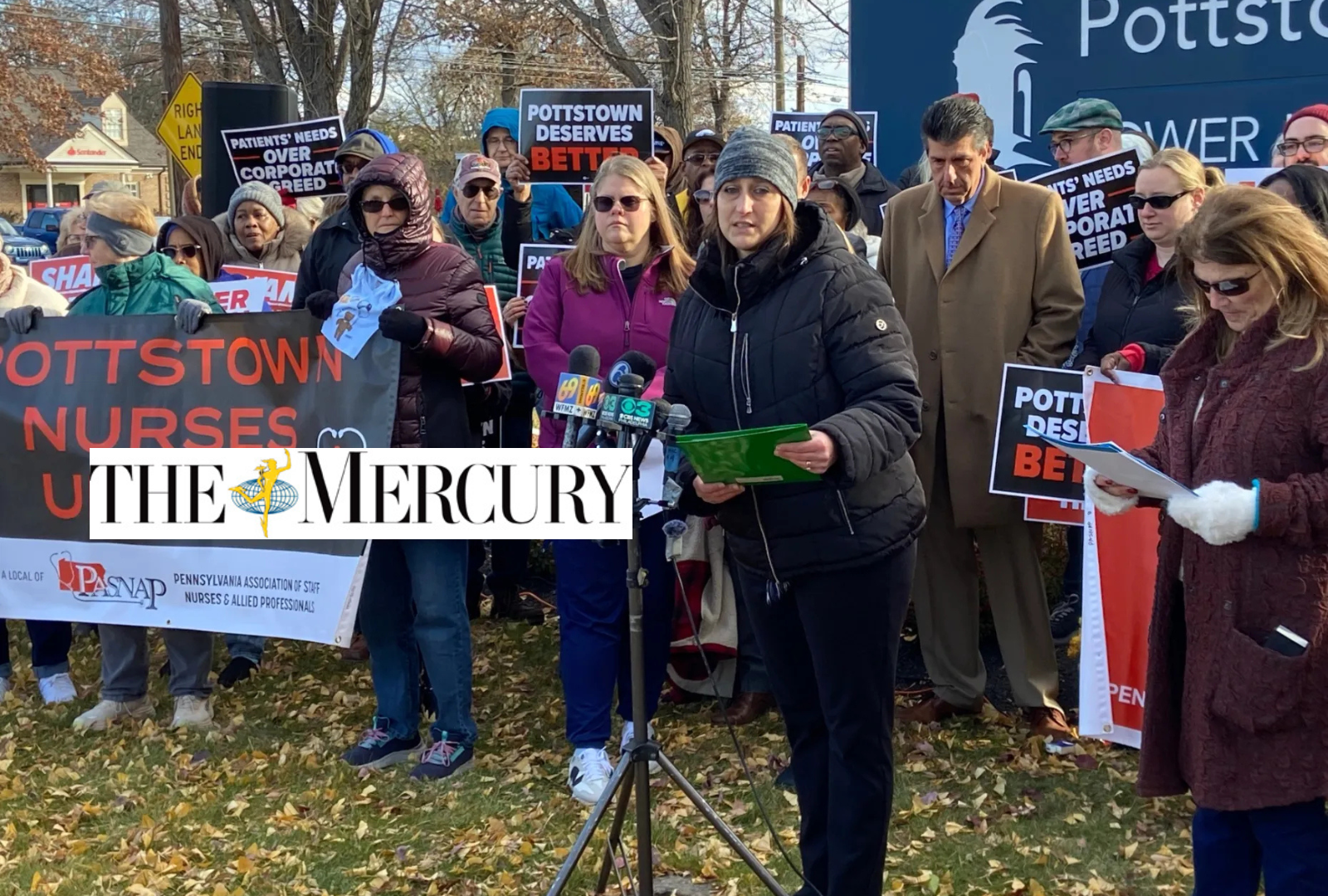
POTTSTOWN — Nurses, patients and politicians gathered in front of Pottstown Hospital Monday morning to demand the hospital’s owner, Tower Health, reverse its recently announced decision to lay off more than 130 people and close several departments there, including the cancer center and the intensive care unit.
Some even went as far as to suggest that the ever-dwindling number of services available at the hospital is all part of a “private equity playbook” headed toward the eventual closure of the hospital.
“We may be looking at this hospital closing,” said state Rep. Joe Ciresi, D-146th Dist. “You don’t just peel away layer by layer and expect the finances to get healthier.”
Tower Health issued the following statement regarding the cuts. “In the face of the major headwinds confronting every health system nationwide, we have taken important steps to transform our operations and build a more nimble and resilient organization. These difficult decisions were not made lightly. They were made out of necessity to ensure that we can chart our own pathway forward and continue serving our communities. Our commitment to award-winning, high-quality care and patient safety remains unwavering.”
“These changes are not simply about reducing costs. They reflect a strategic priority to reinvest savings in the pillars that power our future. That includes expanding our provider network, accelerating innovation through AI and technology adoption and enhancing the overall patient experience” the statement read. “Equally important, as part of our three-year strategic plan, we will focus on strengthening the Tower Experience. This means empowering our employees holistically, fostering growth and development, and creating an environment where every team member feels valued and thrives in support of our patients and one another.”
“With a stronger financial foundation, Tower Health is well-positioned to be the provider of choice in every community we serve, meeting the evolving care needs of our patients today and in the future,” the statement read.
This is the second set of layoffs announced by Tower in the last six months.
In July, Tower confirmed it was laying off 50 employees across its whole system, including management-level roles and vacant positions that will not be filled.
The same month, Tower Health signed a three-year contract with Pottstown Nurses United, representing over 300 nurses — an agreement reached after more than eight months of negotiations.
Then on Nov. 7, the health system announced it is laying off 350 employees, more than 130 of them at Pottstown Hospital alone.
The largest portion of the job losses across all Tower properties will be the result of the closure of three programs at Pottstown Hospital — the McGlinn Cancer Institute, the endoscopy program and the intensive care unit. Health system officials said the majority of the other layoffs are at the executive and administrative level. Further details on those cuts were not immediately available.
Johnny Corson, president of the Pottstown Chapter of the NAACP, noted that the hospital with the most lay-offs is also the only one with workers represented by a union. “Phoenixville is not union. Reading is not union. It makes you wonder what’s going on. Is this about the hospital or is this about the union?” he asked.
Closing the ICU will force people in need of urgent medical care to try to get to Phoenixville or Reading Hospital, both of which are also owned by Tower Health. “So now you’re dealing with the parking lot that used to be called Route 422. Now you get in an ambulance, which has to wade through the traffic on Route 422, that usually would take 20 to 25 minutes, it takes 45 minutes to an hour to get you to where you need to be for ICU care because profit over people happened here at the Pottstown Hospital,” Ciresi said.
The same is true of the patients at Pottstown Hospital’s cancer center, which provides 1,000 cancer infusions each week, said Maria Gutierrez, a sixth-floor nurse who was herself diagnosed with breast cancer. “Getting treatment is extremely tiring and often painful, and it’s often best to be able to sit or lie down afterwards. Making people travel to get those treatments is going to be exhausting,” she said.
Corson is also a cancer patient who is getting treatment in Pottstown.
“I was diagnosed here and we need to stand by the people who are providing this service,” Corson said.
When Tower bought Pottstown Hospital in 2017, some representatives met with the NAACP, “and all they did was they sat there and they lied to us,” said Corson. “I agree with Joe Ciresi, they plan on closing this hospital. You cut the services they have for cancer, the ICU, and the next step is closing.”
“We saw this same thing happen all over Chester County. We know this playbook,” said Ciresi. “This has been the cancer of health care. It’s time to put profit aside,” he said.
Corson added, “The part that really upsets me is they brag on their website about how they partner with Jefferson (Health Systems), they brag about how they partner with Drexel, and they run a nationally-rated cancer center. Well, if you are a nationally rated cancer center, why are you leaving us?” Corson asked. “Why don’t you reach out to Jefferson and the others you partner with? Why don’t you reach out to Penn State University? Tell them, ‘come to Pottstown and help keep our services open.’”
“First, they closed our pediatric ward and then they closed the maternity center,” said Lori Domin, RN, president of Pottstown Nurses United. “Now they are going to hack away at us some more.”
In 2017, Tower Health paid $418 million in cash for the five Community Health Systems Inc. hospitals, including Brandywine Hospital in Coatesville, Chestnut Hill Hospital in Philadelphia, Jennersville Hospital in West Grove, Phoenixville Hospital and what was then known as Pottstown Memorial Medical Center.
In 2021, it sold off Chestnut Hill Hospital and closed Jennersville Hospital. In 2022, it closed Brandywine Hospital.
Tower Health reported $4.2 million in operating profit in the nine months that ended on March 31, The Philadelphia Inquirer reported. However, Pottstown Hospital and Phoenixville Hospital lost a combined $37.3 million during the first nine months of Tower Health’s fiscal year 2025, the Philadelphia Business Journal reported in May.
In the greater Philadelphia area, recent hospital closures have included Hahneman University Hospital in 2019 and this spring, Crozer-Chester Medical Center and Taylor Hospital in Delaware County closed.
According to an August report by the U.S. Government Accountability Office, “there were 118 hospital closures in both rural and urban areas from fiscal year 2019 through fiscal year 2023. Closures of urban hospitals outpaced openings from 2019 through 2023, with 72 closures and 55 openings nationally in this time period. Some of these recent urban hospital closures included a history of private equity investment.
“Last year, Tower hired a private equity-owned company, Ensemble Health Partners, to advise them on how to maximize revenue, according to Tower’s bond filings. Tower is running the private equity playbook, even though they are supposedly a nonprofit,” according to a statement issued by PASNAP prior to Monday’s press conference.
“How can you be a non-profit and stop serving our community?” Domin asked.
“I don’t know how you run a hospital without an ICU,” said ICU patient care tech Cristie Daub. “We have an aging population that is going to need more care, not less. Tower is condemning our community to more sickness, more death.”
Daub, who struggled with emotion as she spoke, said she got kicked so hard by a patient, she needed to get her hip replaced. Then “Tower refused to pay.” As a result of the strain the medical care put on the family’s finances, Daub, a single mother, said, “We got evicted. We just moved into our new place and now I’ve been laid off,” said Daub. “It feels like we’re slowly drowning.”
To make matters worse, “Tower gutted out severance packages one day before sending us letters” about the layoffs,” said Daub.
In those letters to those being laid off, a copy of which was provided by Tower Health, Michael Stern, Tower CEO wrote: “we are streamlining and realigning our leadership and corporate infrastructure to better reflect today’s healthcare realities. These changes are designed to accelerate decision-making and empower teams to act with greater clarity and speed. By evolving how we lead, we are positioning Tower Health to thrive in a rapidly changing environment, while staying true to our mission and values. We have also evaluated services across our hospitals and other sites and are making changes where programs are no longer sustainable or aligned with how and where patients seek care.”
“I know these decisions affect colleagues and friends that we care about deeply. That’s why we are committed to approaching every situation with compassion, respect and support,” Stern wrote in the letter, which makes no mention of the reductions in the severance packages of those who received the letter.
Susan Chetius, an ICU nurse who spoke while still in her surgical scrubs, added that “just 12 hours before they announced they are closing our cancer center, Tower executives were in a bar, holding a fundraiser for the Reading Cancer Center and bragging about it on social media.”
“For all the time I’ve lived here, Pottstown Hospital has had a bad reputation and I have defended it,” Pottstown Mayor Stephanie Henrick said. “I’ve used the intensive care unit, unfortunately. I had my back surgery here and the care I received was amazing. But I have nothing nice to say anymore about Tower Health. It is being run like a for-profit corporation.”
State Rep. Paul Friel, D-26th Dist., said the lives of his wife and son were saved at Pottstown Hospital when problems developed during her pregnancy, and they might have died had the hospital not been so close.
“We really need to start asking ourselves, do we value people, or do we value profits?” said Friel. “This is all part of a deeper structural flaw at Tower designed to provide a short-term profit, not long-term well-being.”
“We need to change the way we manage healthcare in Pennsylvania so that outcomes, not profits, are the measure of success,” he said.
“This is a violent disruption of services and Tower’s obligation to its employees and the community of Pottstown, ” said Beth Ridgely, who works in the hospital’s ICU. “These disruptions will be a death sentence to some.”
Pottstown School Board President Katina Bearden reminded the crowd how many schools, both public and private, are within a short radius around the hospital and expressed concern about when students and staff may need emergency care.
“It’s nice to come out for a photo op, but this is vital for the life of our community and we have to fight to keep it,” Bearden said.
“This hospital is not just a budget on a spreadsheet,” said Denise Williams, who was elected to the Pottstown School Board earlier this month. “This is a town that comes together when the need arises. We may fight amongst ourselves, but we come together when we’re threatened and Tower Health, you picked the wrong community to threaten.”

We use our collective strength to advocate for things like safe staffing, universal access to healthcare, and prevention of harassment and violence against healthcare workers. Our advocacy was instrumental in passing Act 102, Pennsylvania's ban on mandatory overtime for healthcare workers.

3031 Walton Road, Suite C-104 Plymouth Meeting, PA 19462-2326
Copyright © 2022-2025 PASNAP. All Rights Reserved.