
FOR IMMEDIATE RELEASE
TUESDAY, APRIL 1, 2025
CONTACT: Megan Othersen Gorman / [email protected] / (215) 817-5781
IRMC Nurses Picket Outside the Hospital on April Fools Day to Call On IRMC: STOP FOOLING AROUND, PRIORITIZE PATIENT CARE AND NURSE RETENTION, AND COMMIT TO SAFE STAFFING
“We Have All Watched the Exodus of Many Technicians, Therapists, Clerical Worker, LPNs, and Nursing Aides, As They Move On to Greener Pastures. We need the Nurses to Stay. And For That to Happen, Our Skills Need to be Recognized, Valued, and Rewarded.”
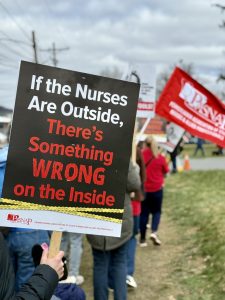
Indiana, PA – 270 RNs at Indiana Regional Medical Center (IRMC) are currently bargaining for their first contract in nearly seven years. At the bargaining table, safe staffing, retention of skilled nurses, and respect for the expertise and dedication IRMC RNs bring to the bedside have emerged as central, connected issues, as management turns a blind eye to all three.
“I’ve spent my entire career at Indiana Regional Medical Center, and in addition to my wonderful family, I consider my time as a nurse serving this community to be my legacy,” says Kim Thomas, RN, who started at IRMC in 1986. “Through my nearly 40 years of service, I’ve advocated tirelessly for this institution, but I cannot say whether my endorsement will continue after this painfully drawn out negotiation process during which we’ve seen efforts to erode our retirement benefits, our paid time off, our staffing assignments, and our nurse-to-patient ratios.”
Given its size and patient volume, IRMC should have 400 nurses. They currently employ approximately 67% of that – a rock-bottom 270 – which is unsafe for patients and nurses alike.
What’s worse, management is actively trying to shirk responsibility for the unsafe staffing levels inside the hospital by refusing to agree to allow the nurses to grieve or to arbitrate any part of their contract regarding staffing. In this community hospital in which they are both the caregivers and those who seek care, the nurses are sounding the alarm.
“‘Safe staffing’ is a little inside baseball, I know – those who aren’t bedside caregivers rarely know what it means,” says IRMC ICU nurse Emily Frey, RN. “So I’ll tell you in nurse terms. Short staffing is when you start the day in the ICU with six patients and four nurses. One nurse promptly gets pulled to another floor that was short-staffed. Then we get five admissions and/or transfers from other floors. We move everyone we can, but two nurses still had three patients apiece and our charge nurse had two patients. These are patients with ventilators, who are going through withdrawal, or who are highly unstable. They should have each had the undivided attention of a nurse. We beg to get our fourth nurse back. We are told, ‘not unless you take five medical/surgical patients with them.’”
“This is chronic short-staffing,” says Frey. “It’s dangerous for our patients and for nurses – and it’s unsustainable.”
When nurses are routinely required to care for more patients than is safe, it’s a crisis for both patients, who receive inadequate care, and nurses, who daily risk both their license and moral injury to care for more patients at a time than is possible to do so safely. What’s more, chronic short-staffing tends to snowball dangerously, as it leads to higher and higher turnover rates.
Because the staffing at IRMC is so low, even the sign-on bonuses the hospital is offering are not working. Nurses come then leave – some even before their contract is up. Chronic short-staffing is leading to intense fatigue, burnout, mental distress, and more and more staff leaving the hospital. It’s simply impossible to recruit and retain skilled nurses when the working conditions won’t allow nurses to provide the level of care they entered the profession to give.
“We have all watched the exodus of many technicians, therapists, clerical workers, and our partners, the LPNs and nursing aides, as they move on to greener pastures,” says Thomas. “We need the nurses to stay. And for that to happen, our skills need to be recognized, valued, and rewarded.”
Wages for nurses at IRMC are well below market, which is a key factor in the hospital’s inability to retain staff. RNs at nearby Punxsutawney Area Hospital and Armstrong County Memorial Hospital, both fellow members of the Pennsylvania Mountains Healthcare Alliance, make demonstrably more, even though IRMC is the largest of the three and absorbs a lot of the overflow from the other two hospitals.
To compound the problem, the current wage scale for nurses at IRMC caps after just 15 years, leaving highly skilled and experienced nurses without meaningful raises for years — often decades. This lack of investment in retaining and rewarding experienced staff isn’t only unfair to nurses, it’s unfair to the IRMC community, since it discourages the retention of experienced nurses and does nothing to foster long-term satisfaction among essential staff.
“IRMC administration’s continued efforts to minimize our worth to this facility display a blatant disregard for the very caregivers who allow this facility to prosper,” says Thomas. “This contract is likely to be my last way, before I retire, to positively contribute to the future of nursing at Indiana Regional Medical Center and the care the Indiana community receives there. Failure to prioritize patient care with a commitment to safe staffing and nurse retention is not an option.”
An informational picket is an event that helps raise community awareness; the caregivers attending the informational picket were either off from work or on a break.
***
Indiana Registered Nurses Association is a local of PASNAP – the Pennsylvania Association of Staff Nurses and Allied Professionals, which represents more than 11,000 frontline healthcare professionals across the commonwealth and was founded 25 years ago on the belief that patients do better when critical care staff have a strong voice to advocate for their patients and themselves.