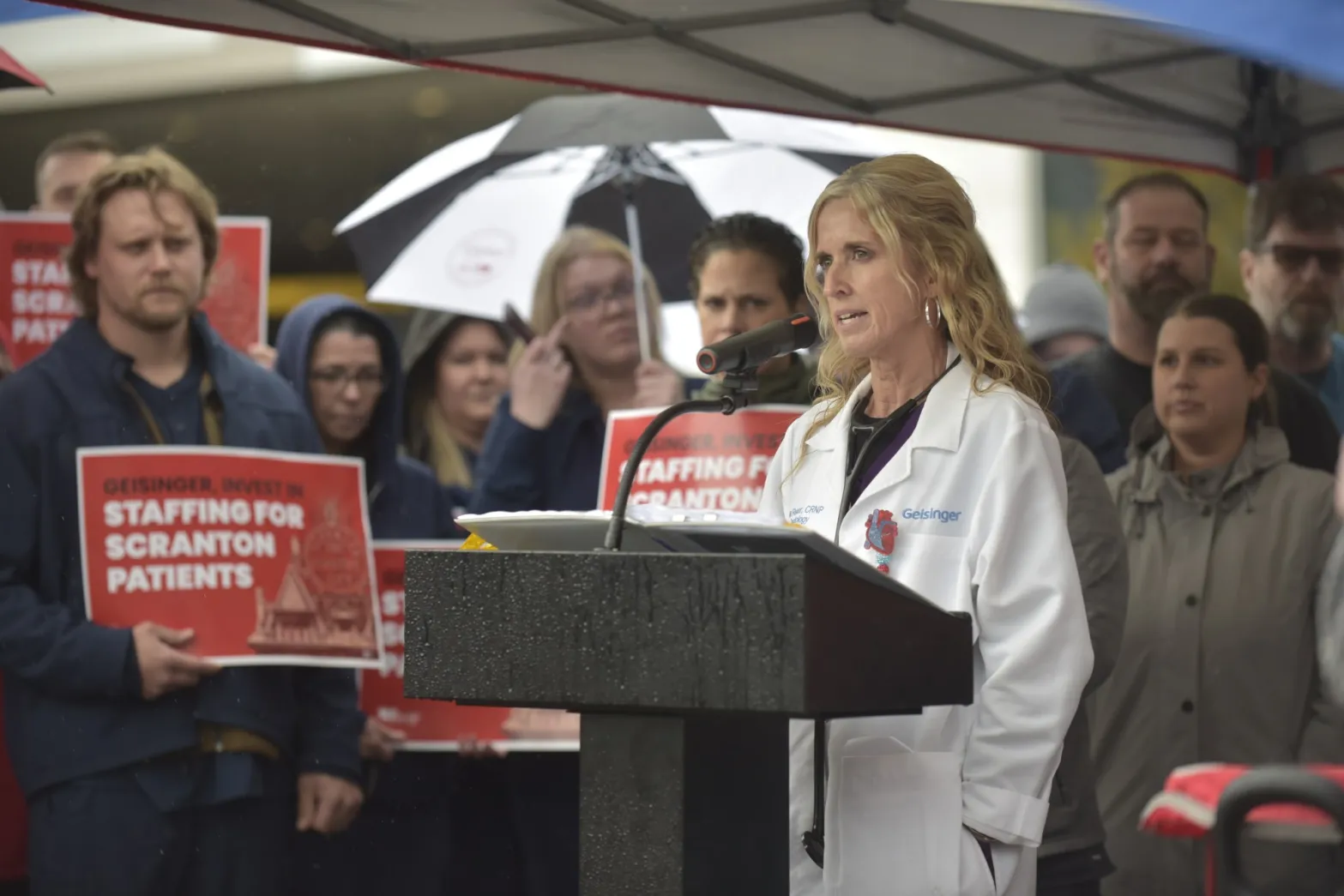
SCRANTON — Union healthcare workers at Geisinger Community Medical Center alleging pay disparities between the Scranton hospital and other Geisinger facilities contend those disparities are driving high turnover that’s disrupting care and placing additional strain on remaining staff.
The unionized technical specialists, professional employees and advanced practice professionals — members of two affiliated locals of the Pennsylvania Association of Staff Nurses and Allied Professionals union — highlighted those concerns Thursday at a rain-soaked press conference outside the Hill Section hospital. They called for market wages and pay equity after delivering a petition demanding the same to Geisinger’s Danville headquarters earlier in the day, PASNAP said.
The GCMC employees pushing the pay issue are members of either the Geisinger Techs and Allied Professionals or Geisinger Advanced Practice Professionals locals of PASNAP, which represents more than 11,000 union healthcare workers statewide. Longtime GCMC Certified Registered Nurse Practitioner Jen Rebar, the president of the advanced practice professionals local, said she and her colleagues “chose to join this union because we believe in having a voice.”
“We advocate for safe staffing, fair working conditions, respect, equitable compensation and making sure our patients get enough time with us so all of their needs are addressed,” she said. “We are also deeply concerned about compensation disparities between facilities within Geisinger. We are here to make sure Scranton does not get left behind.”
A consistent theme of the press conference, where Rebar said union wage concerns have been ignored “time and time again by management,” was that pay differences between facilities drive workers pursuing higher wages to other sites, contributing to a loss of clinical and institutional knowledge at the hospital. Union leaders also argued that high turnover contributes to staff burnout and can impact the care employees provide.
“Healthcare organizations cannot continue to talk about workforce shortages, recruitment challenges and safety issues while overlooking the very clinicians who are already here, already experienced and already committed to caring for this community,” Rebar said. “You cannot expect retention without investment. You cannot expect exceptional patient care while continuously stretching an already overburdened workforce. You cannot expect healthcare professionals to remain silent when they are not being treated fairly.”
PASNAP believes Geisinger is offering nonunion technical and professional employees at campuses near GCMC salaries that are, on average, 15% higher than salaries workers at the hospital are earning in the same positions. It also said more than 150 members of the “techs and pros bargaining unit” at GCMC have left since their contract began in 2024, turnover of more than 30%.
Both PASNAP locals operating under contracts expiring in late April requested wage reopeners to renegotiate terms of those agreements, hoping to address retention challenges, but Geisinger has not accommodated those requests, union officials said.
Geisinger said in a statement that its “PASNAP-represented colleagues are critical to the care we provide at Geisinger Community Medical Center.”
“We value their commitment to serving our community, and we respect their rights as union members,” the health system said. “We’re committed to maintaining the terms of our existing collective bargaining agreements and to engaging in good-faith bargaining in accordance with those agreements.”
Democratic state Reps. Kyle Donahue of Scranton and Kyle Mullins of Blakely delivered remarks in support of the union healthcare workers at Thursday’s event, as did Jen Huber, a GCMC registered nurse and president of the Northeast Pennsylvania Nurses Association, another PASNAP local representing RNs and certified registered nurse anesthetists at the hospital. She spoke in solidarity with her colleagues in the other locals.
“Their call for fair wages is about respect, retaining experienced staff and making sure (the hospital) has the people it needs to care for its community,” Huber said. “When workers leave for better-paying jobs, including (at) nearby hospitals and clinics within Geisinger, we lose trust, co-workers, mentors and invaluable experience.”
Remaining workers shoulder more responsibility and feel the impact, she said, noting experienced staff leaving the hospital represent “years of clinical knowledge” and “countless hours of relationship building with patients and the community.”
“Geisinger talks about investing in Scranton,” Huber said. “Real investment isn’t measured in stories and concrete and steel. Real investment isn’t measured in billboards and scholarships. It’s measured in people who show up every day for their community.”